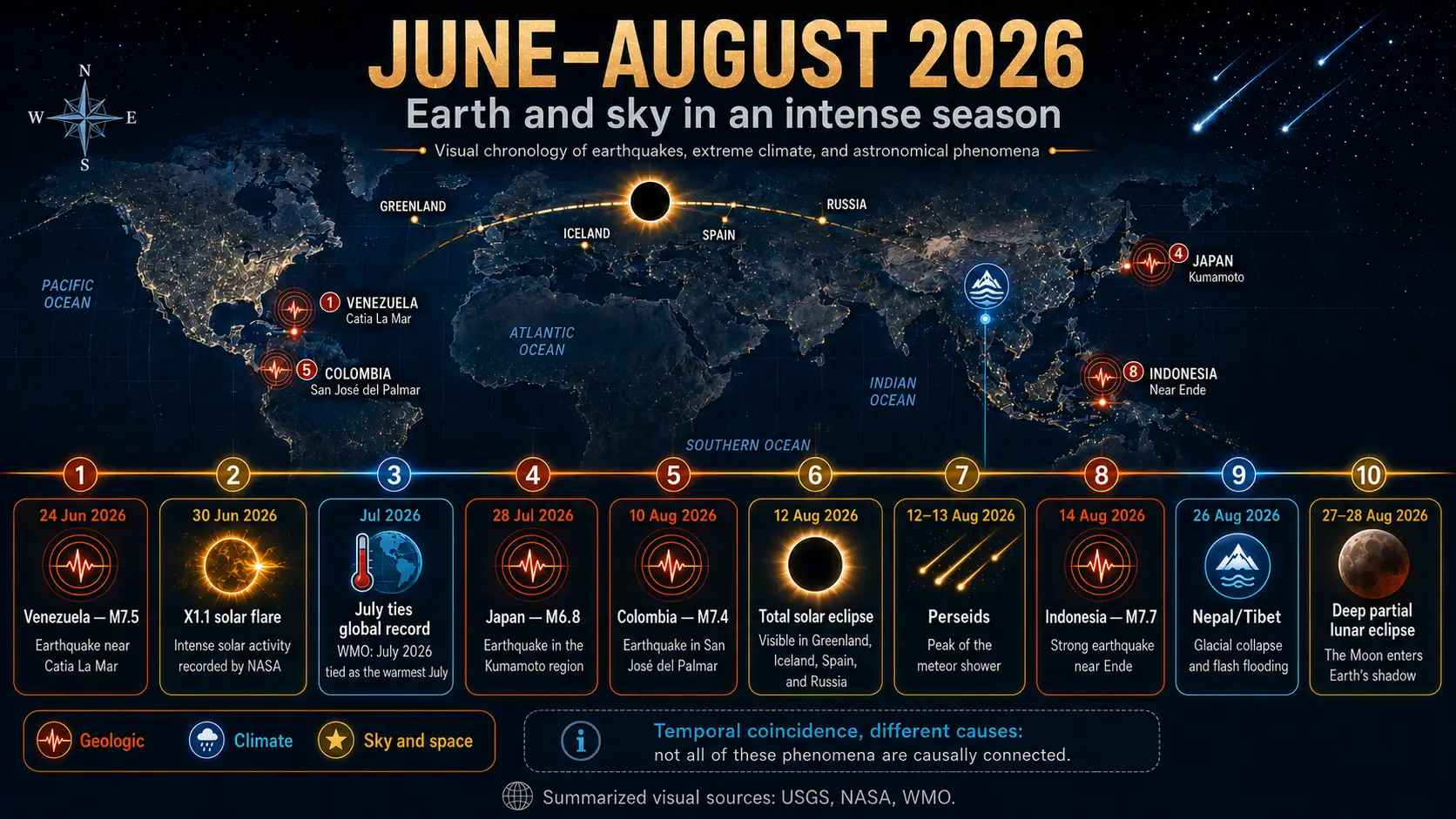
Those of us who have walked and lived in the lands of the Caribbean, North America, and the tropics know that the ground beneath our feet breathes and, sometimes, roars. The period from June to August 2026 will be marked in historical records as a window of time where nature reminded us, with absolute force, of the scale of its power.
Both in the depths of the Earth's crust and in the celestial vault, we witnessed a temporal coincidence of massive events. Although science tells us that these phenomena—geological, climatic, and astronomical—have different causes and are not causally connected, experiencing them in such close succession invites a deep reflection on our fragility and our place in the cosmos.
The Roar of the Earth: Chain Fractures
The global tectonic map seemed to awaken in a symphony of ruptures that shook multiple continents, tracing the tensions of our plates:
- June 24: The Venezuelan coast was struck by a powerful magnitude 7.5 earthquake near Catia La Mar, opening the season with a strong impact in South America.
- July 28: On the other side of the world, the Pacific Ring of Fire made its presence felt with a magnitude 6.8 earthquake in the Kumamoto region of Japan.
- August 10: The tension returned to our hemisphere with a devastating magnitude 7.4 earthquake in San José del Palmar, Colombia, reaffirming the instability of the Nazca and South American plates.
- August 14: Just four days later, Indonesia suffered the strongest blow of this series: a magnitude 7.7 earthquake near Ende.
- August 26: Like a distinct but equally destructive echo, the border between Nepal and Tibet experienced the massive collapse of a glacier and a sudden flash flood.
The Sky Responds: Fire, Shadows, and Stars
While the earth trembled, the skies were not left behind, offering a spectacle of thermal extremes and cosmic wonders:
- June 30: Our Sun unleashed an intense X1.1-class solar flare, a reminder of the fury of our host star.
- July 2026: The global climate reached a boiling point, tying the historical record for the warmest July ever recorded, according to the World Meteorological Organization (WMO).
- August 12: A total solar eclipse crossed Greenland, Iceland, Spain, and Russia, temporarily plunging vast regions into daytime darkness.
- August 12-13: The astronomical darkness coincided beautifully with the peak of the Perseid meteor shower, streaking across the atmosphere in a luminous display.
- August 27-28: The season closes its cycle with a deep partial lunar eclipse, where the Earth's shadow will cloak our satellite.
A Compass for the Future
Seeing this visual chronology laid out before us is an exercise in humility. It reminds us that we inhabit a dynamic world, a living ecosystem where tectonic plates dance to a geological rhythm and the stars follow their unwavering course.
Faced with devastation and extreme phenomena, our greatest strength is not attempting to dominate these forces, but rather understanding them, preparing ourselves, and extending a hand to one another. Solidarity in the face of these natural disasters is the true fabric that sustains our communities. May this record be not just an archive of tragedies and wonders, but a call to global consciousness and the protection of the only home we know.
#NaturalDisasters #Earthquakes #ClimateChange #Nature #PlanetEarth #Solidarity #InMemory #Victims #GlobalConsciousness #ProtectOurPlanet #Reflection #WorldInMotion #ScienceAndNature #Hope #UnitedInSolidarity